by Sheridan Sayles, Rutgers University
Much of what has been written about social media archiving has mostly been in regards to capturing content as it’s created. The Smithsonian Institution Archives saves its Facebook data through PDF captures[1] and North Carolina State University has created a social media capture toolkit[2] for organizations to create social media archives customized to their needs. Furthermore, the National Archives[3] outlines best practices for different organizations to archive their social media. The goal of all of these documents and procedures is to allow organizations to continually save their social media presence and find ways to preserve it according to their use and needs.
What these processes do not answer, though, is what an archivist who receives social media accounts of a defunct organization should do. I am the archivist for the Senator Frank R. Lautenberg Collection at Rutgers University, and I am sharing my story about archiving the late Senator’s Facebook, Twitter, and YouTube accounts.
Senator Lautenberg first began the transfer of his papers to Rutgers after his first period in office around 2001. When he returned to Congress in 2003, his remaining and then newly created materials moved to the record center in Suitland. Upon his death in 2013, 2250 boxes came to Rutgers, and work only began on the papers in July 2015. I started my job a year later—now a full three years since the papers first arrived.
By my first day, the full contents of the collection had already been transferred to Rutgers, and while some born-digital materials were part of this transfer, no information about social media had been included. A month into my position, it occurred to me to Google search the Senator to see which social media accounts his office used. Through this, I discovered his Facebook and Twitter accounts and began the process of figuring out what to do with them. I contacted the Senate Archivist about the accounts and learned that, at the time of the Senator’s death, the Senate had no way to preserve the Senators’ social media accounts and usually cuts off access to official use social media once the Senator has departed. It was likely, then, that no preservation of the social media accounts had been done, and I needed to decide how to proceed.
Unfortunately, the deed of gift provided no clarity on the issue as it only discussed records relating to certain issues and their chain of custody. No mention of audio/visual, digital, or social media records were mentioned anywhere in the deed of gift, and I only found one line that gave me authority to collect and preserve these materials, which was on how Rutgers University Libraries had control over the Senator’s press materials. Since the social media accounts were only maintained for press purposes, I decided that it was important to collect and retain archived versions of the accounts.
Despite having no login information, I ultimately decided to petition Facebook for access to Senator Lautenberg’s page, download the Facebook-created archive before the page cease to exist, preserve the site as close to the original look, and link it to the finding aid. I realized that most of the value of this Facebook page—seeing it as a real page, doing data analysis, and other research possibilities—can best be done on the live page, and my job was to ensure that it was preserved in some way.
I initially tried to find the proper contact at Facebook through searching the companies’ sites. After a few days of searching around and trying to find an email or a phone number, I came up empty handed. I was able to get in contact with someone at the company, however, because an old college classmate is engaged to someone who works at Facebook. I messaged him back and forth for about a month, and through the course of our conversation, he sent my request to the correct department that handles these sorts of issues.
After my contact got in touch with the correct department, he gave me a list of a few items that I needed to provide in order to get access to the account:
- a) A description of your relationship to the Page (and authority to request a change in the admin, as applicable);
- b) The name of the current Page admin(s), as applicable;
- c) The current admin’s original relationship to the Page;
- d) An explanation of your request, and whether there has been a termination of the employment and/or business relationship with the named admin(s), as applicable;
- e) All documentation supporting your request;
- f) The Facebook account or email address associated with the Facebook account (or Timeline) that you wish to have added as the new admin on the Page; and
- g) A declaration under penalty of perjury that the information you have provided is true and accurate (your statement must include this language).
Most of the items on this list could be proved with the deed of gift and a simple explanation of the function of social media in the Senate. I found information on the Senate Archives pages that explained how social media was used in the Senate as well as the role of Senator’s archives, and used that and the cycle of elections to explain my relationship to the page as well as the rotating nature of Senators’ social media accounts. Some other information—such as the name of the account manager—were not transferred to Rutgers with the collection. I collected the remaining information through another old colleague who worked across the hall from Senator Lautenberg’s office. Through a couple of exchanges I learned the name of the person in charge of his social media accounts and she gave me the final bits of information I needed.
I sent all this information to Facebook in a letter, attaching the deed of gift as proof of legal custody, and a month later, I had access to the Facebook account. Since I still had a window open with Senator Lautenberg’s social media manager, I requested information on his YouTube and Twitter accounts, and she gave me access with a few exchanges of emails. Once I had access, I decided that the next best step was to download the archive as given by Facebook, YouTube, and Twitter. This way I could either get the empirical data to recreate the accounts or get the files—such as memes from the Twitter or video files from YouTube—to access later.
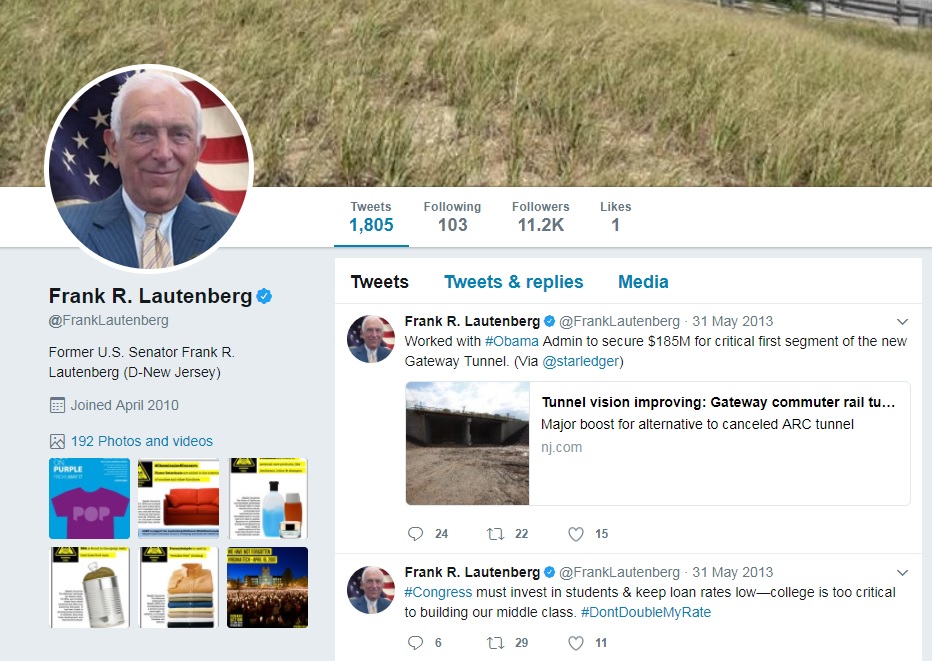

Though I am still working on connecting the social media accounts to the finding aid, I have come to realize two things from that experience. First, keep the conversation about saving social media open when drafting the deed of gift. This whole situation, in which I scrambled for months to collect social media information, could have been avoided if social media had been part of the drafting of the deed of gift and while working on logistics for transferring the collection.
Second, keep in contact with the Senator’s staff. Knowing the right people—such as the Senator’s chief of staff—can open doors to more information about the office that you might not have had before. By building relationships with these people, I was able to get the contact information for the Senator’s social media manager and get access to the Twitter and YouTube accounts. This goes beyond social media and can help you fill in the gaps of other parts of the collection.
Currently, the Senate has contracts with three web/social media archiving vendors, so there is now a way to obtain complete downloads with the “look and feel” of live sites without resorting to the social media platforms. But these only work while the office is open, so it’s still important to get a head start on talking about saving social media and to keep up contacts to ensure a complete and thorough preservation of the sites. Don’t get flatfooted like I was and lose a chance to preserve this important piece of documentation!
You can download a copy of my Facebook petition.
[1] https://siarchives.si.edu/blog/smithsonian-using-and-archiving-facebook
[2] https://www.lib.ncsu.edu/social-media-archives-toolkit
[3] https://www.archives.gov/files/records-mgmt/resources/socialmediacapture.pdf
 Electronic Records Committee